
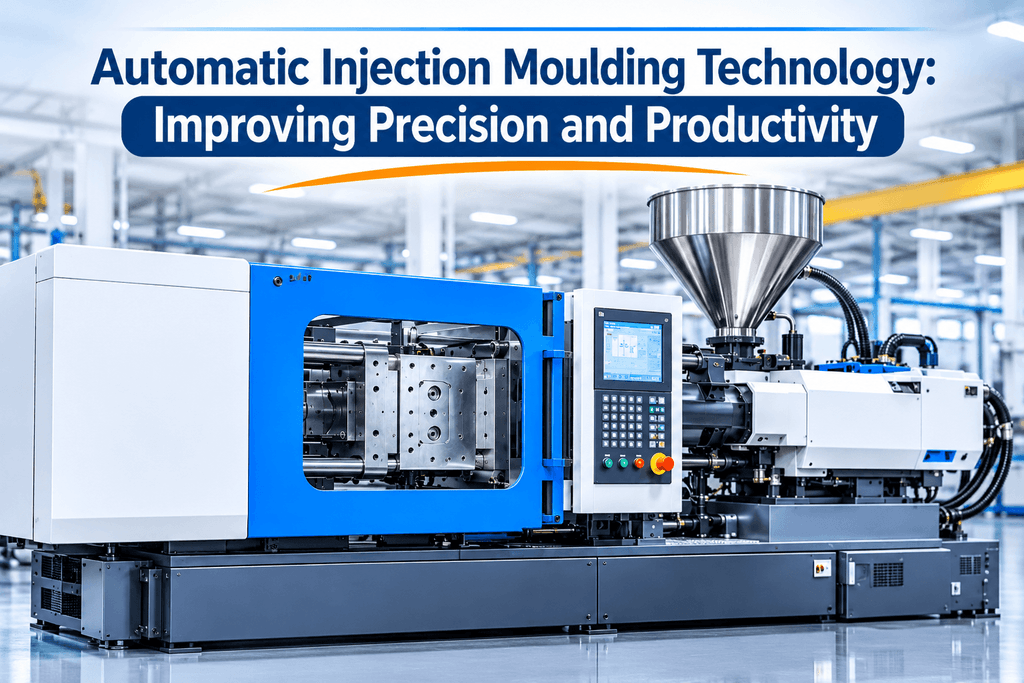
The plastic manufacturing industry is continuously evolving as businesses look for ways to improve product quality, reduce production costs, and meet increasing customer demands. Automation has become an important part of this transformation, particularly in injection moulding, where accuracy, consistency, and production speed directly influence manufacturing performance.
Automatic injection moulding technology helps manufacturers produce plastic components with greater precision, consistent cycle times, and reduced manual intervention. By integrating programmable controls, automated material handling, and advanced monitoring systems, manufacturers can improve operational efficiency while maintaining product quality.
An automatic injection moulding machine is particularly useful for businesses producing automotive components, electrical enclosures, packaging products, medical-related components, and household plastic products. Understanding its technology, benefits, applications, and selection criteria can help manufacturers make informed equipment investments.
What Is Automatic Injection Moulding Technology?
Automatic injection moulding technology is a manufacturing process that uses automated controls to produce plastic components with minimal manual intervention. It manages essential operations such as material feeding, plasticisation, injection, cooling, mould opening, and part ejection. This improves dimensional consistency, production efficiency, repeatability, and manufacturing control.
What Is Automatic Injection Moulding Technology?
Automatic injection moulding is an advanced plastic manufacturing process in which machines perform most production operations according to programmed parameters.
The process begins with plastic granules being fed into a heated barrel. A rotating screw melts and prepares the material before injecting it into a closed mould under controlled pressure. After cooling and solidification, the mould opens and the finished component is removed.
Modern automated systems can coordinate several operations, including:
- Automatic material feeding and conveying.
- Temperature and pressure regulation.
- Injection speed and holding pressure control.
- Mould opening and closing.
- Automatic component ejection.
- Cycle monitoring and production data collection.
These functions help manufacturers maintain repeatable production conditions and reduce dependence on manual operations.
How Does Automatic Injection Moulding Improve Precision?
Precision is essential when producing components that must meet specific dimensions, tolerances, and functional requirements. Even small variations can affect product assembly, durability, and performance.
Automation improves manufacturing accuracy through several important features.
1. Accurate Process Parameter Control
Modern machines use programmable controllers to regulate injection pressure, temperature, screw speed, and holding time. Operators can establish suitable processing settings for different materials and mould designs.
Maintaining consistent parameters helps reduce common defects such as:
- Short shots
- Flash formation
- Sink marks
- Warpage
- Inconsistent component dimensions
However, achieving accurate results also depends on mould quality, material characteristics, machine condition, and proper process validation.
2. Consistent Injection Pressure and Speed
Controlled injection pressure and speed help molten plastic fill mould cavities more uniformly. This is especially important for complex components with thin sections, detailed features, or multiple cavities.
Stable injection conditions can improve surface appearance and reduce dimensional variation between production batches.
3. Improved Temperature Management
Plastic materials require specific processing temperatures. Excessive heat can degrade certain polymers, while insufficient heating may cause incomplete filling or poor surface quality.
Automated temperature control helps maintain suitable barrel and mould temperatures according to the material manufacturer’s processing recommendations.
4. Repeatable Production Cycles
Once a process has been properly established, programmable settings help reproduce similar manufacturing conditions across multiple cycles.
This is valuable for businesses supplying components to industries where consistency and quality documentation are important.
How Does an Automatic Injection Moulding Machine Improve Productivity?
Productivity depends on more than the number of components produced per hour. It also involves machine availability, material utilisation, labour requirements, quality levels, and production planning.
Automation supports better productivity in several ways.
Reduced Manual Intervention
Automatic material feeding, mould movement, and part ejection reduce the need for operators to perform repetitive tasks. Employees can focus on quality inspection, machine monitoring, and production coordination.
Faster and More Consistent Cycle Times
Automated controls help coordinate injection, cooling, mould opening, and ejection operations. This can reduce unnecessary delays and improve production scheduling.
Actual cycle times depend on component design, wall thickness, resin type, cooling requirements, and mould configuration.
Lower Rejection Rates
Consistent process monitoring helps manufacturers identify production variations before they result in large quantities of defective products. Reducing rejection and rework can improve material utilisation and manufacturing efficiency.
Better Production Monitoring
Advanced machines may include digital displays, alarms, production counters, and process records. These features help supervisors monitor machine performance and identify operational problems.
What Features Should Manufacturers Look for in Modern Automated Systems?
Selecting suitable equipment requires evaluating technical specifications alongside actual production requirements.
Important features include:
Programmable Logic Controller (PLC): A PLC manages machine operations through programmed instructions and supports repeatable production settings.
Servo Motor Technology: Servo-driven systems can provide controlled movement and may reduce energy consumption compared with conventional hydraulic arrangements, depending on operating conditions.
Hydraulic and Electric Systems: Hydraulic machines are commonly used for applications requiring substantial clamping force, while electric systems can offer precise movement and energy-efficient operation in suitable applications.
Automatic Ejection Systems: These mechanisms remove finished components from the mould and support continuous production.
Safety Interlocks: Protective guards, emergency stops, and interlocking systems help reduce risks associated with moving machine components.
Process Monitoring: Pressure, temperature, cycle time, and alarm information can help operators maintain production consistency.
Why Should Manufacturers Work with Experienced Plastic Moulding Machine Manufacturers?
Choosing the right machinery supplier is an important part of establishing an efficient production facility. Experienced Plastic Moulding Machine Manufacturers can help businesses identify suitable machine specifications based on component dimensions, material requirements, production volume, and mould design.
Before purchasing equipment, manufacturers should evaluate the following factors:
- Technical expertise: Check the supplier’s experience with different injection moulding applications.
- Machine configuration: Evaluate clamping force, injection capacity, screw diameter, and platen dimensions.
- Customisation: Determine whether the machine can accommodate specific moulding requirements.
- After-sales support: Consider installation, operator training, spare parts availability, and maintenance assistance.
- Documentation: Review technical specifications, operating manuals, warranty conditions, and safety information.
A machine should be selected according to the actual production requirement rather than price or advertised capacity alone.
What Industries Benefit from Automatic Injection Moulding?
Automated injection moulding is used across several manufacturing sectors because it supports repeatable production of plastic components in different shapes, sizes, and materials.
Automotive Industry
Automotive manufacturers use injection moulding to produce dashboards, interior panels, clips, connectors, and other plastic components. Consistent dimensions are important because these parts must fit accurately during vehicle assembly.
Electrical and Electronics Industry
Switch housings, cable connectors, electrical enclosures, and appliance components are commonly manufactured using injection moulding. Proper material selection and process control help achieve the required insulation and mechanical properties.
Packaging Industry
Caps, closures, containers, and packaging components can be produced in large quantities using automated systems. Multi-cavity moulds can further support high-volume production.
Medical and Healthcare Industry
Selected medical-related components, laboratory consumables, and healthcare product housings are manufactured through injection moulding. These applications may require strict material traceability, validated processes, and controlled manufacturing environments.
Consumer Goods Industry
Household products, toys, storage containers, kitchen accessories, and furniture components also benefit from automated plastic processing.
How to Choose the Right Automatic Injection Moulding Machine?
Selecting suitable machinery requires a detailed assessment of production needs. Businesses should consider the following points before making an investment.
1. Evaluate Clamping Force
Clamping force keeps the mould closed during injection. The required capacity depends on the projected area of the component, cavity arrangement, and injection pressure.
An incorrectly sized machine may result in flash, production limitations, or unnecessary operating costs.
2. Check Injection Capacity
The injection unit must provide sufficient material for the complete moulding cycle. Consider component weight, runner weight, resin characteristics, and the machine’s recommended shot-size operating range.
3. Understand Material Compatibility
Different polymers require different processing conditions. Common materials include:
- Polypropylene (PP)
- Polyethylene (PE)
- Acrylonitrile Butadiene Styrene (ABS)
- Polycarbonate (PC)
- Polyamide (PA)
- Polyethylene Terephthalate (PET)
Confirm that the screw, barrel, temperature range, and other machine components are suitable for the intended material.
4. Compare Energy Consumption
Electric, hydraulic, and hybrid machines have different energy requirements and operating characteristics. Compare actual energy consumption under representative production conditions rather than relying only on general efficiency claims.
5. Assess Maintenance and Service Support
Regular maintenance helps protect equipment performance and reduce unexpected downtime. Check the availability of trained technicians, replacement components, preventive maintenance schedules, and technical assistance.
Businesses evaluating plastic injection moulding machine manufacturers in ahmedabad should also examine machine demonstrations, manufacturing capabilities, service infrastructure, and customer references before finalising a supplier.
Automatic vs Conventional Injection Moulding Machines
The main difference between automatic and conventional injection moulding systems is the degree of process automation and operational control. The actual performance depends on machine configuration, mould design, and production conditions.
| Comparison Factor | Conventional Systems | Automatic Systems |
| Material Feeding | May require manual handling | Can use automatic feeders |
| Process Control | More operator-dependent | Programmable controls |
| Component Removal | May involve manual handling | Automatic ejection options |
| Production Consistency | Depends heavily on operator settings | Supports repeatable settings |
| Labour Requirements | Potentially higher | Can reduce repetitive tasks |
| Production Monitoring | May be limited | Digital monitoring options |
| Initial Investment | May be lower | Can be higher |
| Productivity | Depends on operating method | Potential for improved output |
Automation does not automatically guarantee better results. Proper mould design, process optimisation, operator training, and maintenance remain essential.
What Safety Standards and Regulations Should Manufacturers Consider?
Industrial automation must be supported by appropriate safety measures. Injection moulding machines involve high temperatures, moving platens, clamping mechanisms, hydraulic pressure, and electrical systems.
Manufacturers and machine buyers should consider:
- ISO 20430:2020: An international standard covering essential safety requirements for injection moulding machines. ISO confirmed this edition following its 2025 review.
Safety requirements+1 - Bureau of Indian Standards (BIS): BIS provides guidance and assessment checklists for injection moulding machine safety based on IS/ISO 20430.
Bureau of Indian Standards - Occupational safety requirements in India: The Occupational Safety, Health and Working Conditions Code, 2020, includes duties relating to safe machinery design, construction, testing, and information for users. Businesses should verify applicable provisions and state-specific requirements.
IndiaCode
Essential workplace precautions include:
- Install suitable machine guards and safety interlocks.
- Provide accessible emergency stop systems.
- Train operators in safe machine operation.
- Follow lockout and isolation procedures during maintenance.
- Inspect hydraulic connections, electrical systems, and moving components regularly.
- Maintain appropriate ventilation and temperature controls.
Safety requirements should be assessed for the complete production setup, including moulds, robots, conveyors, and auxiliary equipment.
Expert Insights: Best Practices for Better Manufacturing Performance
Manufacturers can improve the results of automated injection moulding by following a structured production management approach.
Optimise mould design: Proper gate placement, cooling channels, venting, and cavity configuration can improve filling and reduce defects.
Maintain processing records: Record important parameters such as melt temperature, injection pressure, cycle time, and cooling time for repeatability and troubleshooting.
Monitor machine performance: Track downtime, rejection rates, cycle times, and overall equipment effectiveness (OEE).
Use preventive maintenance: Inspect screws, barrels, seals, filters, motors, and hydraulic components according to manufacturer recommendations.
Train production teams: Operators should understand machine settings, material handling, safety procedures, and common defect identification.
Calculate the total cost of ownership: Consider the purchase price, electricity consumption, tooling, maintenance, labour, spare parts, and expected production capacity.
Key Takeaways
- Automatic injection moulding improves process control and production consistency.
- Programmable settings help regulate injection pressure, temperature, and cycle operations.
- Automated feeding and ejection can reduce repetitive manual work.
- Machine selection should consider clamping force, injection capacity, material compatibility, and mould dimensions.
- Supplier expertise and after-sales support are important investment considerations.
- Safety standards, operator training, and preventive maintenance are essential for reliable manufacturing.
Conclusion
Automatic injection moulding technology is transforming plastic manufacturing by improving precision, production consistency, and operational efficiency. Advanced controls, automated material handling, and process monitoring help manufacturers maintain product quality while managing increasing production requirements.
Investing in the right automatic injection moulding machine requires careful consideration of material compatibility, clamping force, injection capacity, energy consumption, safety features, and long-term maintenance costs.
An Automatic Plastic Injection Moulding Machine can be a valuable manufacturing investment when its capabilities match actual production requirements. Businesses should also evaluate supplier experience, technical expertise, and after-sales support before making a purchasing decision.
For additional technical information about injection moulding machinery and modern manufacturing solutions, explore the resources and expertise shared by established machine manufacturers such as Parth Plastech.
Faqs
. What is an automatic injection moulding machine?
An automatic injection moulding machine is industrial equipment designed to manufacture plastic components with minimal manual intervention. It automates operations such as material feeding, melting, injection, cooling, mould opening, and component ejection. Programmable controls help maintain consistent production conditions and improve manufacturing repeatability.
What are the major benefits of automatic injection moulding technology?
The major benefits include improved dimensional accuracy, consistent production cycles, reduced repetitive labour, better process monitoring, and potentially lower rejection rates. Automated systems also help manufacturers manage high-volume production more efficiently. However, actual performance depends on machine configuration, mould quality, material selection, and maintenance practices.
Which materials can be processed using automatic injection moulding machines?
Common materials include polypropylene, polyethylene, ABS, polycarbonate, polyamide, and PET. Each polymer has specific melting temperatures, flow characteristics, and cooling requirements. Manufacturers should select machine configurations and processing parameters according to the material supplier’s technical recommendations and the finished product’s performance requirements.
How can manufacturers select the right injection moulding machine?
Manufacturers should evaluate clamping force, injection capacity, screw specifications, mould dimensions, production volume, and energy consumption. They should also assess automation features, safety systems, maintenance requirements, and technical support. Comparing these factors against actual production needs helps businesses select suitable machinery and avoid unnecessary investment.