
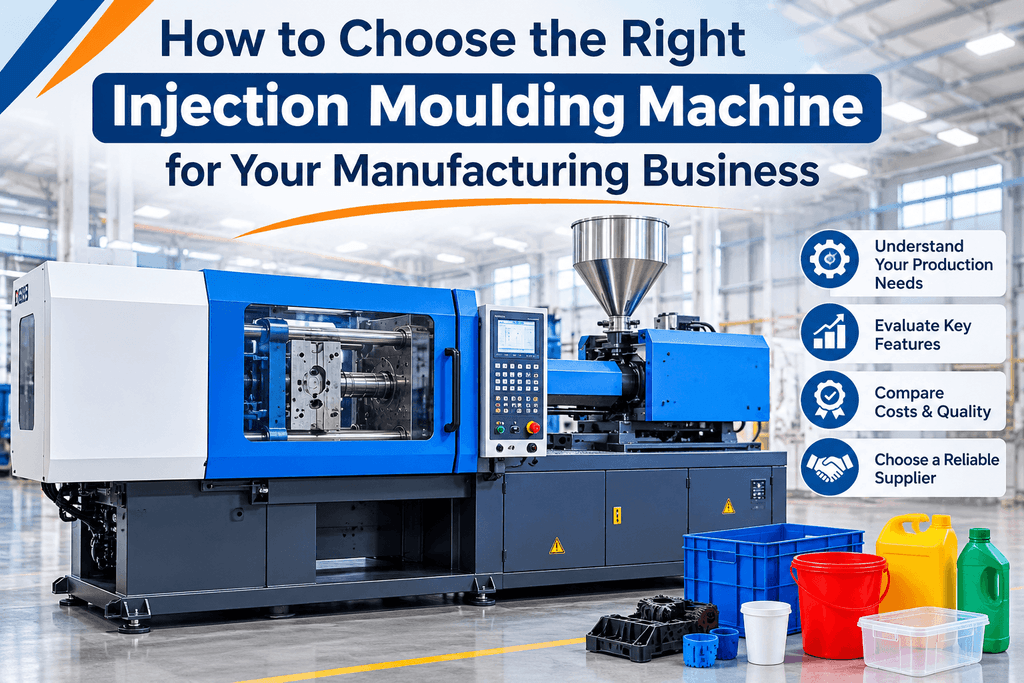
Choosing the right injection moulding machine is essential for manufacturers who want to achieve consistent product quality, efficient production and controlled operating costs. The right machine depends on several factors, including product dimensions, plastic material, mould specifications, production volume and automation requirements.
Whether you manufacture automotive components, household products, packaging materials or industrial parts, selecting suitable machinery can improve production performance. Businesses searching for an injection moulding machine in ahmedabad should compare machine specifications, energy efficiency, maintenance requirements and supplier support before investing.
This guide explains the important factors to consider when selecting an injection moulding machine for your manufacturing business.
How Do You Choose the Right Injection Moulding Machine?
Choose an injection moulding machine based on product weight, mould dimensions, clamping force, injection capacity, plastic material and production volume. Also consider machine technology, energy consumption, automation, maintenance and after-sales support. Matching these specifications with your manufacturing requirements helps improve productivity and avoid unnecessary investment.
Understand Your Manufacturing Requirements
Before purchasing machinery, identify the type of plastic products you intend to manufacture. Different applications require different processing capabilities.
Consider these important factors:
- Product type: Identify whether you manufacture packaging products, automotive components, electrical parts or household items.
- Material: Consider materials such as polypropylene (PP), polyethylene (PE), ABS and polycarbonate (PC).
- Product weight: Determine the component weight and total shot size.
- Production volume: Estimate daily and monthly production targets.
- Product dimensions: Evaluate the size, thickness and complexity of the finished component.
For example, manufacturers producing lightweight packaging containers may require high-speed production capabilities, while automotive component manufacturers may need higher clamping force and greater injection capacity.
Evaluate Clamping Force and Injection Capacity
Clamping force determines how securely the mould remains closed during the injection process. Selecting insufficient clamping force can cause plastic leakage or flash defects.
The required force depends on the projected area of the mould, cavity pressure and material characteristics.
Injection capacity is equally important because it determines how much molten plastic the machine can deliver during each production cycle.
Check the following specifications:
- Clamping force
- Injection pressure
- Screw diameter
- Shot weight
- Plasticising capacity
Selecting suitable specifications helps maintain consistent mould filling and reduces production defects.
Which Type of Injection Moulding Machine Is Best?
Manufacturers can choose between hydraulic, all-electric and hybrid machines depending on their production requirements.
Hydraulic Machines: These machines use hydraulic systems to generate the force required for injection and clamping. They are suitable for various general-purpose manufacturing applications.
All-Electric Machines: These machines use electric servo motors to control operations. They offer precise movement, repeatability and potentially lower energy consumption in suitable applications.
Hybrid Machines: Hybrid technology combines hydraulic and electric systems to balance production performance, precision and energy efficiency.
The best option depends on the product, production volume, investment budget and expected operating costs.
When Should You Consider a Thin Wall Injection Moulding Machine?
Manufacturers producing lightweight plastic containers, cups, lids and packaging products may require specialised high-speed equipment.
A Thin wall injection moulding machine manufacturer focuses on machinery designed for applications involving relatively thin plastic sections and rapid mould filling.
These machines may require:
- High injection speed and pressure.
- Effective cooling arrangements.
- Accurate temperature control.
- Suitable screw and barrel configurations.
- Consistent mould filling.
For example, a manufacturer producing multi-cavity food containers should evaluate whether the machine can fill every cavity consistently while maintaining the required product dimensions.
Check Mould Compatibility
Machine and mould compatibility directly affects production quality. Before purchasing, verify the following specifications:
- Platen dimensions and tie-bar spacing.
- Minimum and maximum mould height.
- Opening stroke.
- Ejector stroke.
- Mould mounting arrangements.
- Cooling system connections.
A machine should accommodate the intended mould without compromising safety, operating performance or component removal.
Consider Energy Efficiency and Total Investment
The purchase price is not the only expense involved in buying an injection moulding machine. Manufacturers should calculate the total cost of ownership.
Important expenses include:
- Initial machine cost.
- Mould and tooling investment.
- Electricity consumption.
- Installation and commissioning.
- Auxiliary equipment.
- Spare parts and maintenance.
- Operator training.
Compare energy consumption under similar operating conditions rather than relying only on advertised efficiency claims.
A machine with a higher initial price may offer better long-term value if its operating costs and maintenance requirements suit your production needs.
How to Select Reliable Machine Manufacturers?
Choosing an experienced supplier is important for maintaining production continuity. When evaluating injection moulding machine manufacturers in ahmedabad, consider their technical knowledge, machine range and customer support.
Before purchasing, check:
- Manufacturing experience and product specifications.
- Previous customer installations.
- Machine demonstration and trial availability.
- Warranty and service conditions.
- Spare parts availability.
- Installation and operator training support.
Request a detailed quotation and compare technical specifications before finalising your purchase.
Check Safety and Quality Standards
Machine safety should be a priority during equipment selection and installation.
ISO 20430:2020 provides safety requirements for injection moulding machines used in plastics and rubber processing. Manufacturers should also check applicable Bureau of Indian Standards (BIS) requirements and relevant Indian factory and machinery regulations.
Important safety features include emergency stops, protective guards, safety interlocks and mould protection systems.
Proper operator training, maintenance documentation and safe operating procedures also help reduce workplace risks.
Comparison of Injection Moulding Machine Types
| Factor | Hydraulic | All-Electric | Hybrid |
| Technology | Hydraulic system | Electric drives | Combined |
| Precision | Application-dependent | Generally high | Generally high |
| Energy efficiency | Model-dependent | Often efficient | Configuration-dependent |
| Maintenance | Hydraulic maintenance | Electrical and mechanical | Both systems |
| Applications | General manufacturing | Precision production | Flexible applications |
The final selection should depend on actual production requirements rather than technology alone.
Common Mistakes to Avoid Before Purchasing
Manufacturers should avoid these common purchasing mistakes:
- Selecting machinery based only on price.
- Ignoring future production requirements.
- Overlooking mould compatibility.
- Underestimating electricity and maintenance costs.
- Not checking supplier service capabilities.
- Skipping machine demonstrations or mould trials.
Always review the machine specifications, warranty terms, installation requirements and expected operating expenses before making a commitment.
Conclusion
Choosing the right injection moulding machine requires careful consideration of production requirements, machine specifications, energy efficiency and long-term operating costs. Businesses should compare different technologies, verify mould compatibility and evaluate supplier support before investing. Working with experienced moulding machine manufacturers in ahmedabad can help manufacturers identify suitable machinery for their applications and future production goals. Visit Parth Plastech at https://parthplastech.com/ to explore injection moulding machine solutions and understand the available manufacturing options.